

Teen Mental Health Treatment With UMR Insurance
If your family has a UMR card through work, your employer's health plan may help pay for your teen's mental health treatment at Horizon Recovery. Coverage depends on your plan. We verify your benefits before admission and put the estimate in writing, so your responsibility is stated before the first day.
Benefits verified within one business day. No obligation.

Matching what you're seeing to a level of care
UMR reviews every request against one question: does your teen need this level of care right now? Parents don't need to know the answer before calling, but it helps to know how the levels differ.
- Residential treatment fits when a teen isn't safe or can't make progress at home, even with outpatient support. Think repeated crises, self-harm, running away, substance use, or months of therapy without improvement.
- Partial hospitalization (PHP) fits when a teen is safe at night but needs treatment most of the day, often right after a hospital or residential stay.
- Intensive outpatient (IOP) fits when a teen can keep going to school but needs several sessions a week to stay steady.
- Outpatient therapy fits when symptoms are manageable, or as the last step after a more intensive program.
If your teen talks about suicide, has a plan to hurt themselves, or you can't keep them safe tonight, call 988 or 911, or go to the nearest emergency room first.
Our clinical assessment makes the recommendation with you.
Understanding Levels of Care goes deeper on each option.
UMR runs the plan. Your employer sets the benefits.
UMR is UnitedHealthcare’s third-party administrator, and one of the largest in the country (UnitedHealthcare). It isn't an insurance policy in the usual sense. Your employer, union, school district or health system pays claims from its own plan, and UMR processes them, manages the network and reviews care.
That has two practical effects for your family:
- Two UMR cards can mean very different coverage. Benefits come from your employer's plan document, not a standard UMR policy. One plan may cover residential treatment readily; another may set limits or exclusions.
- The rules behind the plan are usually federal. Most self-funded plans from private employers fall under ERISA, a federal law, rather than Arizona's insurance department. Plans from public employers, such as cities, school districts and state agencies, and church plans follow different rules.
The document that spells out your benefits is the Summary Plan Description. Your HR department can give you a copy, and you can see benefit details in the UMR member portal.
GEHA plans for federal families are also administered by UMR. If that's your coverage, see our GEHA insurance page.
Talking to HR without giving up your family's privacy
With a self-funded plan, HR is often your best source for plan documents and answers. Many parents worry about what their employer will learn. A few things to know:
- You don't have to share a diagnosis. Asking for the Summary Plan Description, the plan year dates or whether residential treatment is covered doesn't require any detail about your teen.
- Federal privacy rules limit your employer. HIPAA restricts how an employer that sponsors a health plan can use health information from that plan, and it can't be used for employment decisions.
- Time off may be protected. The Family and Medical Leave Act can give eligible employees up to 12 weeks of job-protected, unpaid leave a year to care for a child with a serious health condition. Eligibility depends on your employer's size and your time on the job, so ask HR how it applies to you.
- Some employers make exceptions. In a self-funded plan, the employer writes the rules. If a limit in the plan blocks care your teen needs, HR's benefits team is where that conversation starts.
Which network is on your card
Many UMR plans use the UnitedHealthcare Choice Plus network, with a separate behavioral health directory for counseling and substance use providers. Some employers pick a different network, and the name printed on your card tells you which.
That network name decides whether Horizon is in network for you. We check it during verification. If Horizon is out of network, we'll tell you whether your plan has out-of-network benefits and what they would cost before you decide.
What UMR plans commonly cover for teens
Federal parity law generally requires employer plans that cover mental health care to cover it on terms no more restrictive than medical care, with an exception for some small employers. Within that, your plan document sets the details. Here's what we confirm for each level of care:
We treat depression, anxiety, trauma, self-harm, ADHD and substance use alongside a mental health condition (dual diagnosis). Horizon does not provide detox or medication-assisted treatment.
Prior authorization and ongoing reviews
Higher levels of care generally need approval before admission and regular reviews during treatment. At Horizon, our utilization management team requests authorization and handles those reviews. When coverage is approved "for seven days," that's a review point, not a discharge date. We tell you when each review happens, what was requested and what was decided.
Approval turns on medical necessity. Records from past therapists, psychiatrists and any hospital visits make the case stronger, so it helps to gather what you have.
From first call to first day with UMR
Here's how the process runs with a UMR-administered plan:
- Call or send the verification form. A named admissions team member responds within 30 minutes during business hours.
- We verify your UMR benefits within one business day. That includes the network on your card, your employer's plan rules, deductible, coinsurance, out-of-pocket maximum and authorization requirements.
- We complete a clinical assessment. We collect your teen's history and past records and recommend a level of care. If another setting fits better, we say so.
- You get a written out-of-pocket estimate. You see what your family would owe before you commit.
- We request prior authorization. Our utilization management team submits the clinical documentation and tells you the decision.
- Onboarding day. Your Care Coordinator reaches out within one business day, and an initial treatment plan is in your hands within 72 hours.
- Ongoing reviews and step-down planning. We handle reviews during treatment and arrange the next level of care before your teen leaves the current one.
How coverage changes as your teen steps down
Most teens move through more than one level of care. Under a UMR plan, each level is usually its own authorization with its own cost share. Residential and PHP are billed per day, IOP per session or per day, and outpatient therapy per visit.
We request the next level before the current approval ends, so there's no gap. Before every step, we tell you what changes in cost. Because every level of care at Horizon lives under one program, your teen's documentation stays continuous, which makes each new request easier for reviewers to follow.
If both parents have coverage
A teen covered through both parents' jobs has a primary and a secondary plan. Many plans decide the order for children with the "birthday rule": the plan of the parent whose birthday falls earlier in the year pays first. Self-funded plans set their own coordination rules, and separation, divorce or court orders can change the order. Bring both cards to verification and we'll confirm which plan pays first.
If UMR denies coverage
Most UMR plans follow the ERISA claims process:
- Read the denial letter. It must state the reason and your appeal deadline.
- Request the claim file. You're entitled to copies of the documents behind the decision, free of charge.
- File the internal appeal. Group health plans must give you at least 180 days to appeal a denial.
- Ask for external review if needed. Most plans offer an independent review after the internal appeal.
The U.S. Department of Labor's EBSA helps families with questions about employer plans. Under The Horizon Guarantee, we file the appeal on your behalf at no charge — commitment #11 of the 71 written commitments in The Horizon Guarantee. We can't control the decision. We can make sure the clinical case is complete.
Questions to ask UMR or HR before admission
We ask these for you during verification. If you want to check yourself, call the number on your UMR card or talk with HR:
- Which network is on my card, and how do I search its behavioral health directory?
- Does our plan cover residential treatment centers? Are there limits or exclusions?
- What is my cost share for residential treatment, PHP and IOP, in and out of network?
- Does our plan include out-of-network benefits?
- When does our plan year reset, and how much of our deductible and out-of-pocket maximum have we met?
- Which services need prior authorization, and who requests it?
- Is our plan covered by ERISA, or is it a government or church plan?
- If coverage is denied, what's the appeal deadline and is external review available?
Keep a note of the date, the representative's name and a reference number for each call.
Treatment at Horizon Recovery
Horizon Recovery runs residential homes and outpatient locations across the Phoenix metro area. Every level of care lives under one program, so your teen doesn't restart with a new team at each step. The next step is arranged before your child leaves the one they're in.
- Joint Commission accredited
- One named Care Coordinator, introduced to you within one business day of admission, who checks in with you every week of the stay
- A weekly call with your teen's primary clinician, plus family therapy
- Neurofeedback and 19-channel qEEG brain mapping — a separate self-pay program: we provide a superbill your family can submit to your plan, and during verification we check whether your plan’s codes allow reimbursement — and medication management
- School continues: a two-hour school block every weekday through Alta Independent, a Cognia-accredited school (how credits apply is always the receiving school’s decision)
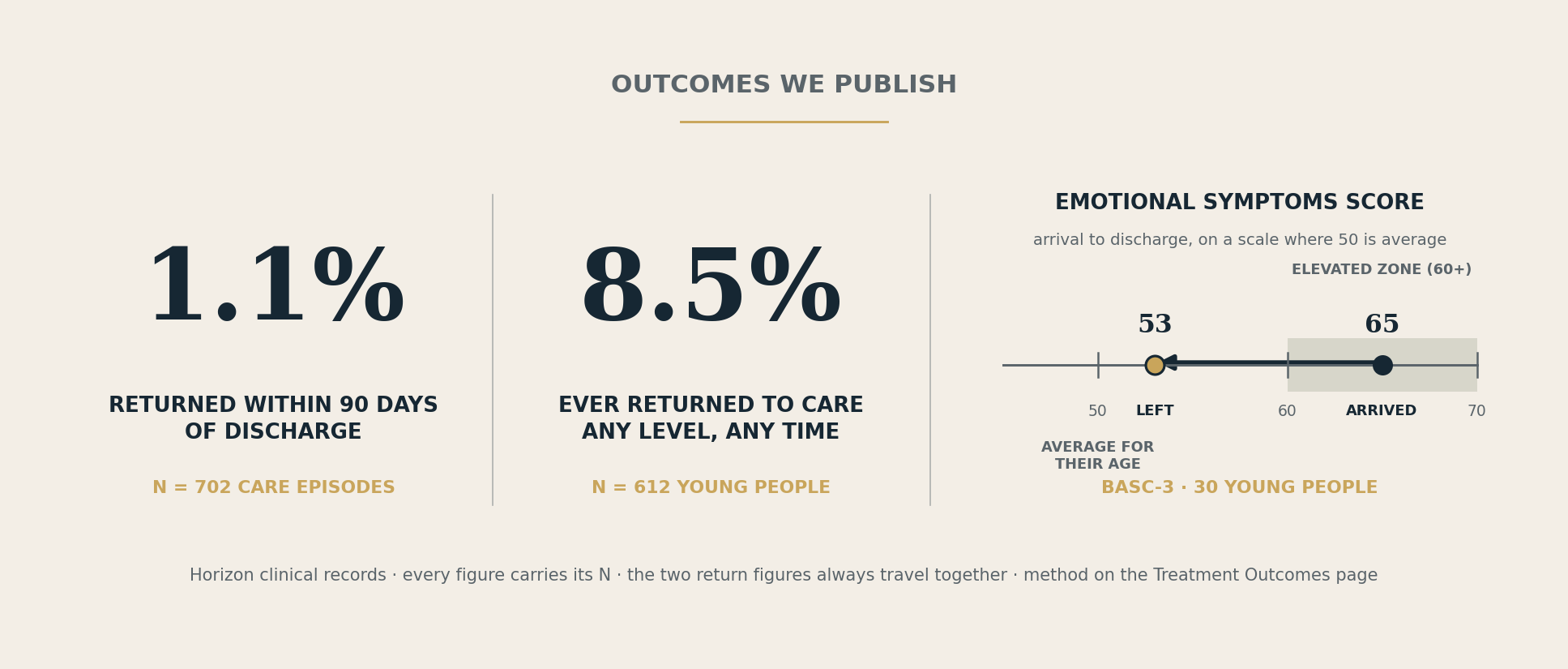
Two numbers to take into every comparison call: 1.1% of care episodes returned within 90 days of discharge (N = 702), and 8.5% of the young people in our current records have ever returned to care — any level, any time (N = 612).*1
On the BASC-3 emotional symptoms score, where 50 is average for their age and 60 or above is the elevated zone, this group arrived at 65 and left at 53 — 80% of the way back to average (30 young people).*2 We have not found another Arizona adolescent program that publishes its outcomes (reviewed September 2026).
Before choosing any program, see what it measures.
Ours is on the Treatment Outcomes page.
Our list of Questions Worth Asking Any Teen Treatment Program works for every call you make, and How Teen Treatment Is Paid For covers the terms you'll hear along the way.
Verify your UMR benefits
Have these ready:
- Your UMR member ID card, front and back, including the network name
- The plan member's name, date of birth and employer
- Your teen's date of birth
- Your Summary Plan Description, if you have it (helpful, not required)
Our admissions team responds within 30 minutes during business hours — and within 12 hours after hours — verifies benefits within one business day, and gives you a written out-of-pocket estimate before you commit.
Verify my UMR benefits · Call (602) 755-7858
If your teen is in immediate danger, call 911 or the 988 Suicide & Crisis Lifeline.
UMR terms you'll see
*1 Horizon clinical records: returns within 90 days of discharge, 702 care episodes; ever returned at any level, 612 young people in current records. A return within seven days of discharge is counted as the same admission. These two figures always appear together.
*2 Horizon clinical records: BASC-3 emotional symptoms, intake 65 to discharge 53, where 50 is the age average and 10 points is one standard deviation; 30 young people with a scored measure at both ends of a stay; p < 0.001.
UMR and teen treatment: frequently asked questions
Many UMR-administered plans do, when a teen meets medical necessity criteria and prior authorization is approved. Because each employer designs its own plan, the only way to know is to check yours. Coverage depends on your plan. We verify your benefits before admission and put the estimate in writing, so your responsibility is stated before the first day.
UMR is a UnitedHealthcare company, but it administers employers' self-funded plans rather than selling insurance policies. Many UMR plans use UnitedHealthcare's network, while your employer's plan decides the benefits.
Ask HR for your Summary Plan Description, or look in the UMR member portal. Or skip the reading: send us your card and we'll verify your benefits within one business day.
It depends on your plan, but residential and partial hospitalization care almost always need it. We check your plan's requirements and request authorization for you.
No. Horizon does not provide detox or medication-assisted treatment. We treat substance use together with the mental health condition underneath it. If your teen may need detox first, tell our admissions team and we'll talk through where to start.
We file the appeal at no charge (commitment #11 of The Horizon Guarantee), and no charge appears on a statement without prior written communication (commitment #10). We'll also walk you through the levels of care your plan does cover and what each would cost.
Sometimes. In a self-funded plan, the employer sets the rules and can choose to approve an exception. It isn't guaranteed, but it's worth asking HR's benefits team, especially when a limit blocks care your teen's clinicians recommend.
Federal privacy rules limit how an employer can use health information from its health plan, and it can't be used for employment decisions. You don't need to share a diagnosis to ask HR about benefits.
You may qualify for job-protected leave under the Family and Medical Leave Act to care for a child with a serious health condition. Eligibility depends on your employer and your work history, so ask HR. Our admissions team can talk you through what the paperwork usually needs.
Horizon's outpatient therapy serves young people up to age 21, and adult children can stay on a parent's plan until age 26. Once your child turns 18, they'll need to sign a release before we can share treatment details with you.
Our empathetic and caring team is here to support you every step of the way.