

Teen Mental Health Treatment With Aetna Insurance
If your teen needs more than weekly therapy and your family has Aetna, your plan may help pay for treatment at Horizon Recovery. Coverage depends on your plan. We verify your benefits before admission and put the estimate in writing, so your responsibility is stated before the first day.
Benefits verified within one business day. No obligation.

What you might be seeing at home
Aetna, like every insurer, pays for the level of care your teen needs right now. So the first step is being honest about what's happening at home. These are common situations families describe when they call, and where each one usually leads:
These are starting points, not diagnoses. Our clinical assessment makes the recommendation, and it becomes the documentation Aetna reviews.
Start with your plan type
With Aetna, the most useful thing to know first is what kind of plan you have. It shapes your network, your costs and your appeal rights.
- Most Aetna coverage now comes through an employer. Aetna stopped selling individual plans on the Affordable Care Act marketplace in 2026 (Fierce Healthcare). If you have Aetna today, it very likely comes through work.
- Fully insured or self-funded. Some employers buy an Aetna insurance policy. Others pay claims themselves and hire Aetna to run the plan. Both cards say Aetna. The difference decides where an appeal goes, so it's worth asking HR.
- HMO, EPO, PPO or POS. Some Aetna HMO and EPO plans won't authorize care outside their network. PPO and POS plans often include out-of-network benefits.
We sort all of this out during verification, so you don't have to decode it on your own.
Aetna through work: what to ask HR
Your HR or benefits team can answer three questions that make verification faster and your estimate more accurate:
- Is our plan fully insured or self-funded? This decides whether state insurance rules or federal ERISA rules apply to appeals.
- When does our plan year start? Many employer plans don't reset on January 1. A stay that crosses the reset can mean a second deductible.
- Can I have the plan documents? Ask for the Summary Plan Description or certificate of coverage. It lists covered services, exclusions and limits.
You don't need to tell HR your teen's diagnosis to ask any of these. Your benefits questions are about the plan, not your child.
What Aetna covers for teen mental health
Aetna plans include behavioral health benefits across levels of care, from outpatient therapy through residential treatment (Aetna mental health overview). What your specific plan pays, and when, is set by your plan documents.
At Horizon, we get prior authorization before every level of care, not just residential. Some plans may still decline a program because of network rules or plan limits, which is why we verify first.
We treat depression, anxiety, trauma, self-harm, OCD and substance use alongside a mental health condition (dual diagnosis).
How Aetna decides on a level of care
Like every insurer, Aetna approves care based on medical necessity: whether your teen needs this level of care now, not only whether treatment would help. Reviewers typically look at:
- How severe the symptoms are, and whether there are safety risks to your teen or others
- Whether lower levels of care were tried and didn't hold
- How daily life is affected: school attendance, grades, relationships, any hospital visits
- Whether your teen needs round-the-clock structure to make progress
The clinical assessment at onboarding creates the documentation Aetna reviews, so it matters financially as well as clinically. Records from past therapists, psychiatrists and hospital stays make the case stronger. Our utilization management team handles Aetna's ongoing reviews and tells you each time one happens, what was requested and what was decided.
From first call to first day with Aetna
Here's how the process runs with an Aetna plan:
- Call or send the verification form. A named admissions team member responds within 30 minutes during business hours.
- We verify your Aetna benefits within one business day. That covers plan type, network status, deductible, coinsurance, out-of-pocket maximum and authorization requirements.
- We complete a clinical assessment. We collect your teen's history and records from past providers and recommend a level of care. If another setting fits better, we tell you.
- You get a written out-of-pocket estimate. You see what your family would owe before you commit.
- We request prior authorization from Aetna. Our utilization management team submits the clinical documentation and tells you the decision.
- Onboarding day. Your Care Coordinator reaches out within one business day, and an initial treatment plan is in your hands within 72 hours.
- Ongoing reviews and step-down planning. We handle Aetna's reviews during treatment and arrange the next level of care before your teen leaves the current one.
How Aetna coverage follows your teen through treatment
Most teens don't stay at one level of care from start to finish. They step down from residential to PHP, then IOP, then outpatient therapy. With Aetna, each level is a new authorization, and each carries its own cost share.
We request the next level before the current approval ends, so coverage doesn't lapse between steps. Before each step, we tell you what changes: billing may move from per day to per session, and outpatient visits often switch to a copay. Because Horizon keeps every level of care under one program, your teen keeps the same clinical picture on file, and Aetna's reviewers see continuous documentation rather than a fresh start.
Using out-of-network benefits with Aetna
If Horizon is out of network for your Aetna plan, that isn't automatically a dead end. When your plan includes out-of-network benefits, we can work with it once prior authorization is approved. Out-of-network care usually means a higher deductible and coinsurance, and we put those numbers in writing before admission.
If no in-network program can meet your teen's clinical needs, we can help request a single case agreement, which asks Aetna to cover your teen's care with Horizon specifically.
How Teen Treatment Is Paid For explains how those requests work.
If your Aetna plan doesn't cover everything
When coverage falls short, you still have options, and we'll walk through each one with you:
- A review of which levels of care your plan covers, and what each would cost you. Coverage depends on your plan; we tell you before you commit.
- An appeal for a denied authorization, filed at no charge under The Horizon Guarantee — commitment #11 of 71
- A single case agreement request when network options don't fit your teen's needs
- Using HSA or FSA funds toward deductibles and coinsurance
- A written financial agreement that shows what's due, when, and what happens if the length of stay changes
If both parents have coverage
When your teen is on two plans, one is primary and pays first. For a child on two plans, the "birthday rule" often decides which one is primary: the plan of the parent whose birthday falls earlier in the calendar year. Separation, divorce and court orders can change that. Bring both cards to verification and your estimate will account for both plans.
Young adults 18 to 21 on a parent's Aetna plan
Horizon's outpatient therapy serves young people up to age 21, and under federal law, adult children can stay on a parent's plan until age 26. Two things change at 18:
- Privacy. Your young adult controls their own health information. They'll need to sign a release before we can share treatment details with you, and Aetna may need their authorization before discussing claims with you.
- Paperwork. Explanation of Benefits statements may be addressed to your young adult. If you're handling the bills, talk with them about how you'll see those.
If Aetna denies coverage
Start with the denial letter. It names the reason and the deadline for an internal appeal. Most plans also offer an independent external review if the internal appeal is denied.
Where the appeal goes depends on your plan. A fully insured Aetna plan follows state insurance rules. A self-funded employer plan that Aetna administers usually falls under ERISA, and the U.S. Department of Labor's EBSA helps with questions about those plans. If your employer's plan is run by a different administrator, our UMR insurance page covers how self-funded plans work.
We file the appeal on your behalf at no charge — commitment #11 of the 71 written commitments in The Horizon Guarantee. We can't promise Aetna's answer. We can make sure the record behind it is complete.
Questions to ask Aetna before admission
We ask these for you during verification. If you want to call Aetna yourself, use the member services or behavioral health number on your ID card and ask:
- Is my plan an HMO, EPO, PPO or POS, and does it include out-of-network benefits?
- Is my plan fully insured or self-funded?
- What is my cost share for residential treatment, PHP and IOP, in and out of network?
- How much of our deductible and out-of-pocket maximum have we met, and when does the plan year reset?
- Which services need precertification, and who requests it?
- Are there exclusions or limits for residential treatment centers?
- Does my plan offer behavioral health case management?
- If coverage is denied, what's the appeal deadline and is external review available?
Write down the date, the representative's name and a reference number for each call.
Treatment at Horizon Recovery
Horizon Recovery runs residential homes and outpatient locations across the Phoenix metro area. Every level of care lives under one program, so your teen doesn't restart with a new team at each step. The next step is arranged before your child leaves the one they're in.
- Joint Commission accredited
- One named Care Coordinator, introduced to you within one business day of admission, who checks in with you every week of the stay
- A weekly call with your teen's primary clinician, plus family therapy
- Neurofeedback and 19-channel qEEG brain mapping — a separate self-pay program: we provide a superbill your family can submit to your plan, and during verification we check whether your plan’s codes allow reimbursement — and medication management
- School continues: a two-hour school block every weekday through Alta Independent, a Cognia-accredited school (how credits apply is always the receiving school’s decision)
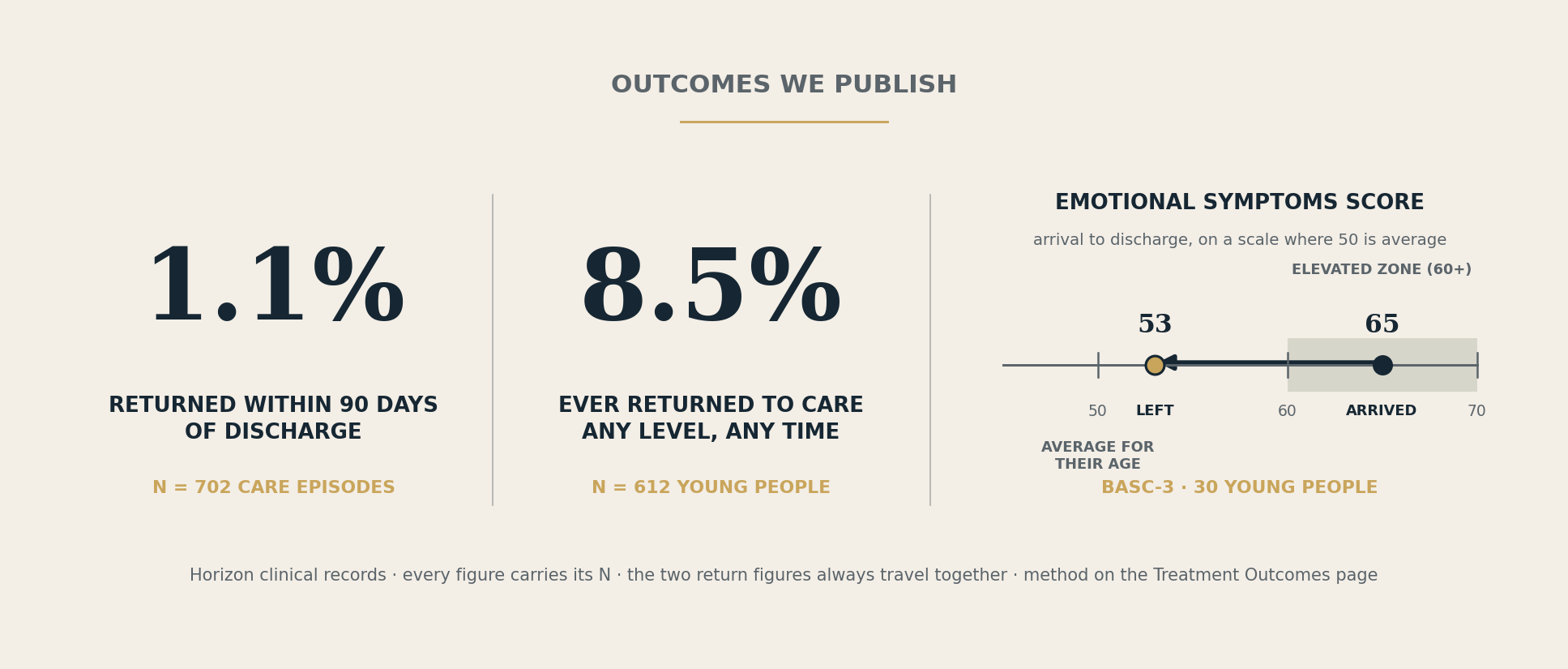
Our published outcomes, for discharges from January 1 to October 1, 2026: 67.0% of young people improved on depression symptoms (PHQ-9, N = 97; average score 15.4 at intake, 8.4 at discharge), and 7.2% got worse. 73.6% improved on anxiety symptoms (GAD-7, N = 91). 8.0% returned to care within 90 days of discharge (N = 261).*1
The median stay was 35.5 days across all stays, and 42.0 days for stays of 7 days or more (N = 384).*2 We have not found another Arizona adolescent program that publishes its outcomes (reviewed September 2026).
Compare programs on proof, not just price. See what we measure on our Treatment Outcomes page, and use our Questions Worth Asking Any Teen Treatment Program with every program you call, including us.
Verify your Aetna benefits
Have these ready:
- Your Aetna member ID card, front and back
- The plan member's name, date of birth and employer
- Your teen's date of birth
- Any past treatment records you already have (helpful, not required)
Our admissions team responds within 30 minutes during business hours — and within 12 hours after hours — verifies benefits within one business day, and gives you a written out-of-pocket estimate before you commit.
Verify my Aetna benefits · Call (602) 755-7858
If your teen is in immediate danger, call 911 or the 988 Suicide & Crisis Lifeline.
Aetna terms you'll see
*1 Horizon Outcomes Data, published website figures (October 8, 2026), for discharges January 1 to October 1, 2026: PHQ-9 depression scale, 67.0% improved and 7.2% worsened (N = 97; mean score 15.4 at intake, 8.4 at discharge); GAD-7 anxiety scale, 73.6% improved (N = 91); returned to care within 90 days of discharge, 8.0% (N = 261).
*2 Horizon Outcomes Data, same window: median length of stay 35.5 days across all episodes and 42.0 days for stays of 7 or more days (N = 384).
Aetna and teen treatment: frequently asked questions
Many Aetna plans cover residential mental health treatment when a teen meets medical necessity criteria and prior authorization is approved. Coverage depends on your plan. We verify your benefits before admission and put the estimate in writing, so your responsibility is stated before the first day.
At Horizon, we obtain prior authorization before every level of care. You don't have to request it yourself; we handle it and tell you the result.
Yes, if your plan includes them. Many PPO and POS plans do; many HMO and EPO plans don't. We'll tell you which you have during verification.
Inpatient psychiatric care happens in a hospital and focuses on short-term crisis stabilization. Residential treatment is a structured, 24-hour therapeutic setting for teens who are safe enough to leave the hospital but not ready for outpatient care. Horizon provides residential treatment, not hospital inpatient care, and insurers review the two separately.
If your plan leaves a gap, it shows up in your written estimate before admission — on paper, not on a bill later. If there’s a gap, we'll go through the options above with you before you decide.
Aetna plans generally include substance use disorder benefits alongside mental health benefits. Horizon treats substance use together with the mental health condition underneath it. We do not provide detox or medication-assisted treatment.
Aetna's individual marketplace plans ended after 2025. If you enrolled in a new plan for 2026, that plan's rules now apply, even if you still have an old Aetna card. Send us your current card and we'll verify the new coverage.
Coverage is reviewed as treatment goes on, and Aetna can decide a level of care is no longer needed. We tell you when each review happens. If Aetna ends coverage before your teen is ready, we file the appeal at no charge and talk through the next level of care your plan does cover.
Federal privacy rules limit how employer health plan information can be used, and employers can't use it for employment decisions. You don't need to share your teen's diagnosis with HR to ask about benefits.
No. Aetna plans often have national networks, and PPO and POS plans may include out-of-network coverage. If you're coming from another state, we verify how your plan treats care in Arizona before you decide.
You Are Not Alone
Caring professionals are available 24/7 to listen and provide assistance. For more resources and information, visit the Suicide & Crisis Lifeline website.
Our empathetic and caring team is here to support you every step of the way.