

Teen Mental Health Treatment With GEHA Insurance
If your family is covered through GEHA, your plan can help pay for your teen's mental health or substance use treatment at Horizon Recovery. Coverage depends on your plan. We verify your benefits before admission and put the estimate in writing, so your responsibility is stated before the first day.
Benefits verified within one business day. No obligation.

How GEHA works for federal families
GEHA, the Government Employees Health Association, offers health plans to federal employees, retirees, postal workers and their families. Because it's a federal benefit, a few things work differently than a typical employer plan. Three are worth knowing before you call anyone.
- Your network is UnitedHealthcare's. In Arizona, GEHA's medical plans use the UnitedHealthcare Choice Plus network (GEHA networks by state). Mental health providers are listed in that network's behavioral health directory.
- Your paperwork may say UMR. Since January 2025, UMR, a UnitedHealthcare company, has administered GEHA plans. A letter or portal that says UMR is still your GEHA plan. More on UMR on our UMR insurance page.
- Your option sets your cost. GEHA's High, Standard, HDHP and Elevate options each carry a different deductible and coinsurance. Your plan brochure lists them.
What GEHA covers for teen mental health
GEHA's plan brochures list residential treatment center stays, partial hospitalization, intensive outpatient and outpatient therapy under Mental Health and Substance Use Disorder benefits. Whether a specific stay is paid depends on medical necessity: GEHA's review of whether your teen needs that level of care right now.
We treat depression, anxiety, trauma, self-harm and substance use that shows up alongside a mental health condition (dual diagnosis).
Precertification: the step that protects your benefits
GEHA requires precertification before a residential treatment center admission. The facility usually requests it, but GEHA holds you responsible for making sure it happens. In GEHA's 2026 brochures, skipping it costs $500 for an in-network stay, or $500 for each day not precertified out of network (2026 plan brochure).
If GEHA decides a stay wasn't medically necessary, it pays only for services it would have covered on an outpatient basis. Out-of-network facilities must also agree to GEHA's terms before admission.
At Horizon, our utilization management team requests precertification and handles GEHA's ongoing reviews during the stay. We tell you when a review happens, what GEHA asked for, and what it decided.
GEHA also expects a residential program to document a treatment plan, progress, a discharge summary and follow-up care. Horizon puts each in writing: an initial treatment plan within 72 hours, a confirmed first aftercare appointment before discharge, and a complete written discharge plan within 24 business hours of discharge.
What your family will pay
Your share depends on four things: your GEHA option, your deductible, your coinsurance, and whether Horizon is in network for your plan. We confirm each one during verification and give you a written out-of-pocket estimate before you commit.
GEHA's 2026 Standard Option summary shows how the numbers are laid out.
One timing detail: GEHA deductibles run on the calendar year. A stay that crosses January 1 can mean meeting a new deductible.
The terms behind all of this are explained in How Teen Treatment Is Paid For.
If GEHA denies coverage
Federal plans don't follow the appeal path most employer plans use. The disputed claims process is in Section 8 of your GEHA brochure:
- Ask GEHA in writing to reconsider, within six months of its decision.
- If GEHA upholds the denial, ask the U.S. Office of Personnel Management (OPM) to review it, within 90 days of GEHA's reconsideration letter.
Under The Horizon Guarantee, when a carrier denies coverage we file the appeal on your behalf at no charge — commitment #11 of the 71 written commitments in The Horizon Guarantee. GEHA's decision isn't ours to control. Making sure the clinical record behind the request is complete is.
Treatment at Horizon Recovery
Horizon Recovery runs residential homes and outpatient locations across the Phoenix metro area. Every level of care lives under one program, so your teen doesn't start over with a new team when they step down. The next step is arranged before your child leaves the one they're in.
- Joint Commission accredited
- One named Care Coordinator, introduced to you within one business day of admission, who checks in with you every week of the stay
- A weekly call with your teen's primary clinician, and family therapy built into the plan
- Neurofeedback and 19-channel qEEG brain mapping — a separate self-pay program: we provide a superbill your family can submit to your plan, and during verification we check whether your plan’s codes allow reimbursement — and medication management
- School continues: a two-hour school block every weekday through Alta Independent, a Cognia-accredited school (how credits apply is always the receiving school’s decision)
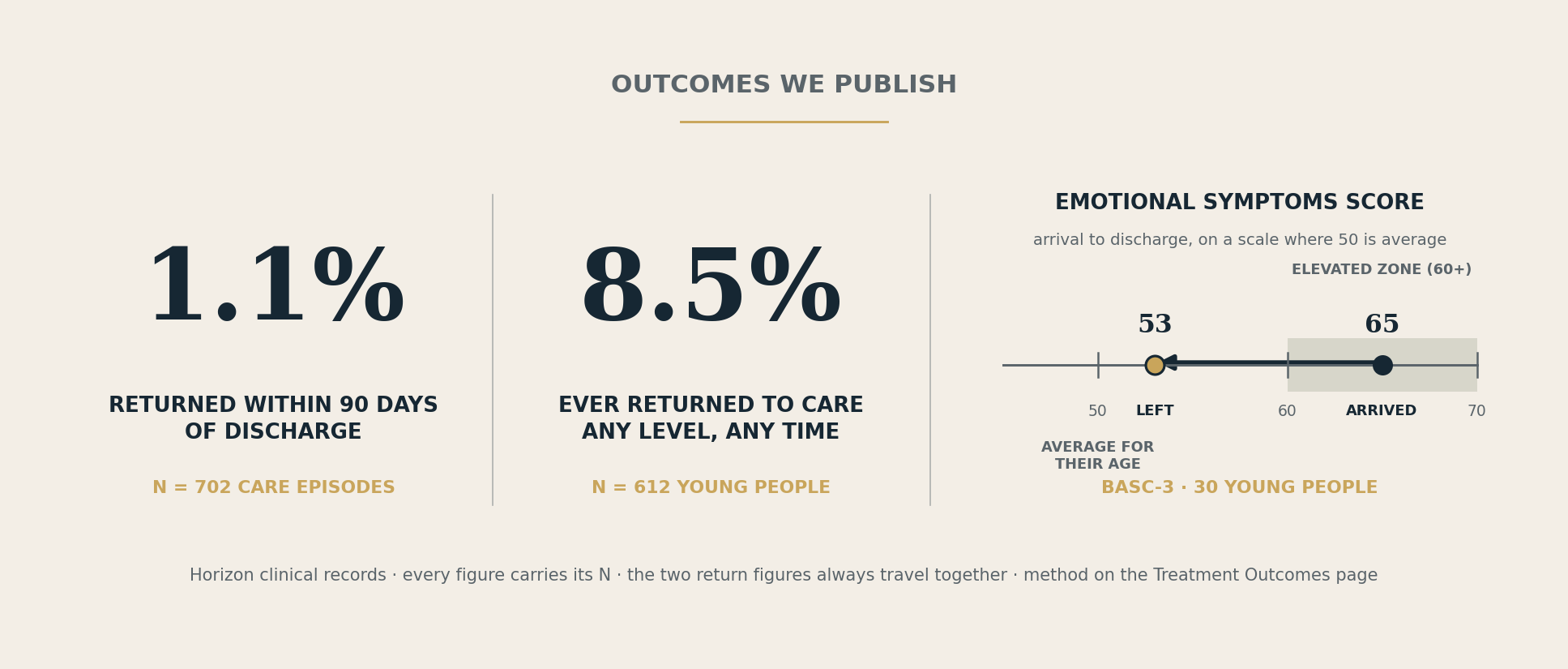
Two numbers to take into every comparison call: 1.1% of care episodes returned within 90 days of discharge (N = 702), and 8.5% of the young people in our current records have ever returned to care — any level, any time (N = 612).*1
On the BASC-3 emotional symptoms score, where 50 is average for their age and 60 or above is the elevated zone, this group arrived at 65 and left at 53 — 80% of the way back to average (30 young people).*2 We have not found another Arizona adolescent program that publishes its outcomes (reviewed September 2026).
Before you choose any program, see what we measure on our Treatment Outcomes page and bring our list of Questions Worth Asking Any Teen Treatment Program to every call.
Verify your GEHA benefits
Have these ready and verification takes one call:
- Your GEHA member ID card, front and back
- The plan member's name and date of birth
- Your teen's date of birth
- Which GEHA option you're enrolled in, if you know it
Our admissions team responds within 30 minutes during business hours — and within 12 hours after hours — verifies benefits within one business day, and gives you a written out-of-pocket estimate before you decide anything.
Verify my GEHA benefits · Call (602) 755-7858
If your teen is in immediate danger, call 911 or the 988 Suicide & Crisis Lifeline.
*1 Horizon clinical records: returns within 90 days of discharge, 702 care episodes; ever returned at any level, 612 young people in current records. A return within seven days of discharge is counted as the same admission. These two figures always appear together.
*2 Horizon clinical records: BASC-3 emotional symptoms, intake 65 to discharge 53, where 50 is the age average and 10 points is one standard deviation; 30 young people with a scored measure at both ends of a stay; p < 0.001.
GEHA and teen treatment: frequently asked questions
GEHA plans list residential treatment center stays under mental health and substance use disorder benefits, with precertification required before admission. Approval depends on whether your teen meets medical necessity for that level of care. Coverage depends on your plan. We verify your benefits before admission and put the estimate in writing, so your responsibility is stated before the first day.
Network status depends on your GEHA option and on which Horizon location your teen would attend. We confirm it during verification, before you commit to anything.
GEHA's substance use disorder benefits sit alongside its mental health benefits. Horizon treats substance use together with the mental health condition underneath it. We do not provide detox or medication-assisted treatment.
UMR, a UnitedHealthcare company, has administered GEHA plans since January 2025. Your benefits are still set by your GEHA plan brochure, and your network is still UnitedHealthcare's.
If another group plan, such as a spouse's employer plan, is primary for the stay, GEHA's brochure says its own precertification isn't required for that facility stay. The primary plan's rules apply first. Tell us about both plans and we'll verify them together.
There's no set number of days. GEHA approves care in segments and reviews it as treatment goes on, based on your teen's clinical progress. We keep you informed after every review.
We file the appeal at no charge. We also walk you through the other levels of care your plan does cover and what each would cost you, so you're never left without a next step.
Our empathetic and caring team is here to support you every step of the way.