

Anthem Insurance Mental Health Coverage for Teens
Anthem insurance mental health coverage for teens can include residential treatment, partial hospitalization, intensive outpatient and outpatient therapy when your teen's needs meet that plan's criteria. Coverage depends on your plan. We verify your benefits before admission and put the estimate in writing, so your responsibility is stated before the first day.
Benefits verified within one business day. No obligation.

Anthem in Arizona: what's different
Anthem is the Blue Cross Blue Shield company in a group of states that doesn't include Arizona. Here, the local Blue plan is Blue Cross Blue Shield of Arizona. Families who use Anthem at Horizon usually fit one of two situations:
- You live in Arizona, but your coverage comes through an employer based in an Anthem state.
- You live in an Anthem state, such as California, Colorado, Georgia, Nevada or Ohio, and you're considering treatment in Arizona.
Either way, the BlueCard program connects Blue plans across the country. Your Anthem plan still decides your benefits. Arizona providers that contract with Blue Cross Blue Shield of Arizona are generally in network for most members of other Blue plans. A suitcase logo on your member ID card is a sign your plan takes part.
Plan type still matters. Some Anthem HMO and EPO plans pay nothing outside their own network except in emergencies. We confirm your plan type and Horizon's network status for your plan during verification.
Which states Anthem covers
Anthem's parent company, Elevance Health, is the Blue Cross Blue Shield licensee in California (as Anthem Blue Cross), Colorado, Connecticut, Georgia, Indiana, Kentucky, Maine, Missouri (outside the Kansas City area), Nevada, New Hampshire, New York (as Anthem or Empire in parts of the state), Ohio, Virginia (outside the Washington, D.C. suburbs) and Wisconsin (Elevance Health SEC filing).
If the state on your plan documents is one of these, your plan's rules come from there, even when your teen receives care in Arizona.
For families with a California Anthem Blue Cross plan
California has some of the strongest mental health coverage protections in the country. Under Senate Bill 855, fully insured, state-regulated plans must base medical necessity decisions on generally accepted standards of care. For mental health reviews of children and teens ages 6 to 17, that means criteria from nonprofit clinical associations, such as CALOCUS or CASII, rather than a plan's own proprietary guidelines (Manatt summary of the California rules).
Two things to know. First, the law applies to fully insured plans regulated by California. A self-funded employer plan that Anthem administers usually falls under federal rules instead. Second, if your California plan is covered, the protection travels with the plan, so it matters even for treatment in Arizona. We check which kind of plan you have during verification.
Who reviews your teen's care: Carelon Behavioral Health
In many Anthem states, Carelon Behavioral Health manages mental health and substance use benefits on Anthem's behalf. Carelon is part of Elevance Health, Anthem's parent company. So the approvals and ongoing reviews for residential, PHP and IOP care may come from Carelon even though your card says Anthem.
At Horizon, our utilization management team handles those reviews. We tell you when one happens, what was requested, and how it affects coverage going forward.
What Anthem mental health coverage for teens usually includes
Federal parity law generally requires plans that cover mental health care to cover it on terms no more restrictive than medical and surgical care (CMS overview). In practice, your plan approves care one level at a time, based on medical necessity.
We treat depression, anxiety, trauma, self-harm, suicidal thoughts and substance use alongside a mental health condition (dual diagnosis).
Is it time for a higher level of care?
Parents usually start looking at treatment programs when the plan they have stops working. A few patterns tend to mean weekly therapy isn’t enough on its own:
- Symptoms keep getting worse even with therapy and medication
- School has stalled: missed days, failing grades or refusal to go
- Self-harm, running away, aggression or substance use keeps coming back
- Home has become a cycle of crises, and the rest of the family is running on empty
If your teen talks about suicide, has a plan to hurt themselves, or you can’t keep them safe tonight, call 988 or 911, or go to the nearest emergency room first. Treatment decisions come after your teen is safe.
For everything short of an emergency, the question is which level of care fits. That’s also the question Anthem asks when it reviews a request. Our clinical assessment answers it with you, and Understanding Levels of Care explains each option in plain language.
Choosing treatment in Arizona when you live out of state
Sending your teen to another state is a hard call. What parents usually want to know is whether they'll still be part of it. At Horizon, you will be.
- You stay in the room. You get a weekly call with your teen's primary clinician, and family therapy is part of the plan.
- Visits happen on time. Scheduled virtual visits start within five minutes of the scheduled time. If your teen declines, a staff member still joins to meet with you.
- One person carries the details. Your named Care Coordinator reaches out within one business day of admission and checks in every week.
- Discharge isn't a handoff into nothing. A first aftercare appointment, with a named provider and a date, is confirmed before your teen leaves.
One financial detail for out-of-state families: employer plans don't always run on the calendar year, and a stay that crosses your plan-year reset can mean a second deductible.
How Teen Treatment Is Paid For explains how to plan around it.
For the practical side, see What Parents Can Expect, what to bring and our locations.
From first call to first day with Anthem
Here's what the process looks like with an Anthem plan:
- Call or send the verification form. A named admissions team member responds within 30 minutes during business hours.
- We verify your Anthem benefits within one business day. That includes BlueCard participation, plan type, the state your plan comes from, network status and who handles authorizations.
- We complete a clinical assessment. We gather your teen's history and records from providers back home, then recommend a level of care.
- You get a written out-of-pocket estimate. You see what your family would owe before anything is signed.
- We request prior authorization. Our utilization management team submits the clinical documentation to Anthem or Carelon and tells you the decision.
- We help you plan the trip. If you're coming from out of state, we walk through arrival, what to bring and how the first days work.
- Onboarding day. Your Care Coordinator reaches out within one business day, and an initial treatment plan is in your hands within 72 hours.
Staying connected to care back home
Treatment in Arizona works best when it connects to the life your teen is going back to. With your written permission, we coordinate with your teen's therapist, psychiatrist and pediatrician at home, so records come in at admission and a plan goes back out at discharge.
- Prior records help Anthem's reviewers see what's already been tried, which strengthens the authorization request.
- School keeps going. Your teen attends a two-hour school block every weekday through Alta Independent. How each credit applies is always your home school's decision, and we tell you that up front.
- Aftercare is booked before discharge. A named provider and a date are confirmed wherever your family lives, and your plan's network is checked for that provider too.
- Stepping down can happen closer to home. If PHP or IOP near home makes more sense than staying in Arizona, we'll plan that transition with you.
If both parents have coverage
Teens with two parents on two plans have primary and secondary coverage. For children, most plans use the "birthday rule": the plan of the parent whose birthday comes earlier in the calendar year pays first. For separated or divorced parents, a court order or custody arrangement can change that. When both plans are Blue plans in different states, the order still matters. Share both cards during verification and we'll sort out which pays first.
If Anthem denies or shortens coverage
The most common denial at higher levels of care is that a teen "doesn't meet criteria" for that level. It's also one of the most appealable, especially when records show lower levels of care were tried and didn't hold.
Where your appeal goes depends on how your plan is funded. A fully insured Anthem plan follows the insurance rules of the state where it was issued. A self-funded employer plan that Anthem administers usually falls under ERISA, a federal law. Ask your HR department which you have, or we'll help you find out during verification.
Under The Horizon Guarantee, when a carrier denies coverage we file the appeal on your behalf at no charge — commitment #11 of the 71 written commitments in The Horizon Guarantee. We can't control the decision. We can make sure the clinical case is complete.
Questions to ask Anthem before admission
We ask these during verification. If you'd rather call Anthem yourself, use the member services number on your ID card and ask:
- Does my plan participate in BlueCard, and does it cover care out of state?
- Is my plan an HMO, EPO, PPO or POS, and does it have out-of-network benefits?
- Is my plan fully insured or self-funded, and which state issued it?
- Who reviews mental health authorizations for my plan: Anthem or Carelon Behavioral Health?
- What is my cost share for residential treatment, PHP and IOP?
- When does my plan year reset, and how much of our deductible and out-of-pocket maximum have we met?
- Are there any exclusions or limits for residential treatment centers?
- If coverage is denied, what's the deadline to appeal and where does it go?
Note the date, the representative's name and a call reference number each time. They matter if you ever appeal.
Treatment at Horizon Recovery
Horizon Recovery runs residential homes and outpatient locations across the Phoenix metro area. Every level of care lives under one program, so your teen doesn't restart with a new team at each step. The next step is arranged before your child leaves the one they're in.
- Joint Commission accredited
- Neurofeedback and 19-channel qEEG brain mapping — a separate self-pay program: we provide a superbill your family can submit to your plan, and during verification we check whether your plan’s codes allow reimbursement — and medication management
- School continues: a two-hour school block every weekday through Alta Independent, a Cognia-accredited school
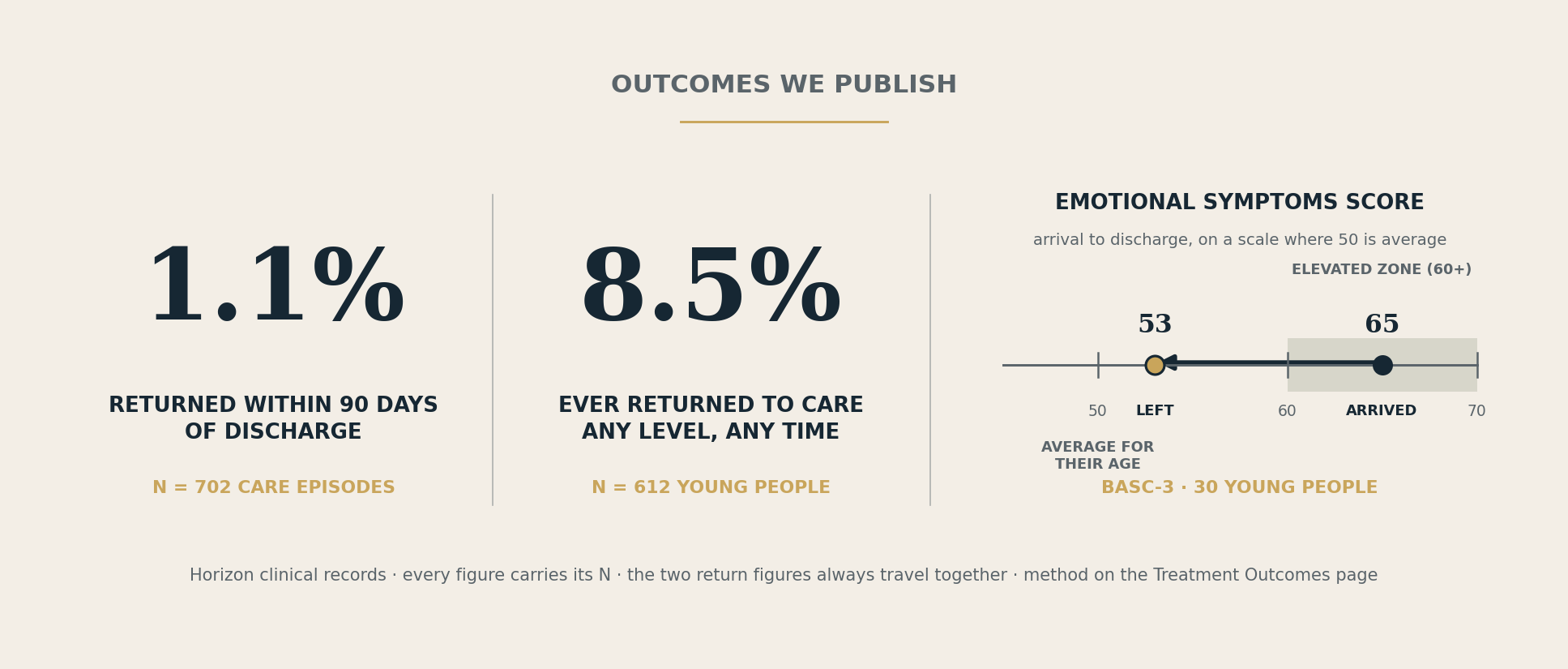
Two numbers to take into every comparison call: 1.1% of care episodes returned within 90 days of discharge (N = 702), and 8.5% of the young people in our current records have ever returned to care — any level, any time (N = 612).*1
On the BASC-3 emotional symptoms score, where 50 is average for their age and 60 or above is the elevated zone, this group arrived at 65 and left at 53 — 80% of the way back to average (30 young people).*2 We have not found another Arizona adolescent program that publishes its outcomes (reviewed September 2026).
Before choosing any program, look at what it measures and publishes.
Ours is on the Treatment Outcomes page, and our list of Questions Worth Asking Any Teen Treatment Program works for every program you call.
Verify your Anthem benefits
Have these ready:
- Your Anthem member ID card, front and back, including the three-character prefix before the member number
- The plan member's name, date of birth and employer
- Your teen's date of birth
Our admissions team responds within 30 minutes during business hours — and within 12 hours after hours — verifies benefits within one business day, and gives you a written out-of-pocket estimate before you commit.
Verify my Anthem benefits · Call (602) 755-7858
If your teen is in immediate danger, call 911 or the 988 Suicide & Crisis Lifeline.
Anthem terms you'll see
*1 Horizon clinical records: returns within 90 days of discharge, 702 care episodes; ever returned at any level, 612 young people in current records. A return within seven days of discharge is counted as the same admission. These two figures always appear together.
*2 Horizon clinical records: BASC-3 emotional symptoms, intake 65 to discharge 53, where 50 is the age average and 10 points is one standard deviation; 30 young people with a scored measure at both ends of a stay; p < 0.001.
Anthem mental health coverage for teens: frequently asked questions
Many Anthem plans cover residential mental health treatment when a teen meets medical necessity criteria, with prior authorization before admission. Coverage depends on your plan. We verify your benefits before admission and put the estimate in writing, so your responsibility is stated before the first day.
Often, yes. Through the BlueCard program, Anthem members can use Blue plan networks outside their home state, and your Anthem plan still sets your benefits. HMO and EPO plans can be more restrictive, so we check your plan type first.
Anthem is the Blue Cross Blue Shield licensee in its own states. Its parent company changed its name from Anthem, Inc. to Elevance Health in 2022, but the plans still carry the Anthem name.
In many Anthem states, Carelon Behavioral Health handles mental health and substance use authorizations for Anthem. We work with whichever reviewer your plan uses and keep you updated after every review.
Most Anthem plans include substance use disorder benefits alongside mental health benefits. Horizon treats substance use together with the mental health condition underneath it. We do not provide detox or medication-assisted treatment.
No. Verification carries no obligation. If another setting would serve your teen better, we'll tell you.
It depends on your plan. Many HMO plans cover only in-network care except for emergencies, and some have limited coverage outside the home state. We check first. If the plan won't cover Horizon, we'll tell you plainly and talk through other options, including a single case agreement when no in-network program can meet your teen's needs.
Generally, the rules of the state that regulates your plan apply wherever care happens. If you have a fully insured California plan, California's mental health coverage protections usually come with it. Self-funded employer plans follow federal rules instead.
Yes. Family involvement is part of treatment, and we'll explain the visit schedule during onboarding. Weekly virtual visits and a weekly call with your teen's primary clinician keep you involved between trips.
Horizon's outpatient therapy serves young people up to age 21, and many young adults are still on a parent's plan. Once your child turns 18, they'll need to sign a release before we can share treatment details with you.
Our empathetic and caring team is here to support you every step of the way.