

Start here · If you're worried
Begin with a quick screener to sort ordinary adolescence from something worth a closer look, then read up on what the early signs actually mean — and how to raise it with your teen.
Free parent screeners · a few minutes each
These screeners are informational. They cannot diagnose your teen or decide the level of care they need — a clinical assessment does that.
The signs that go beyond a bad week.
Take the screener → ScreenerAttention, focus, and impulsivity — what's worth evaluating.
Take the screener → ScreenerMood swings bigger than typical teenage ups and downs.
Take the screener → ScreenerWhen worry stops looking like ordinary stress.
Take the screener →The four questions clinicians use to separate ordinary adolescence from a real problem — plus the signs that need same-day attention.
Read the guide → RecognizingWhat the early signs actually mean, and the first steps that help instead of escalating.
Read the guide → In crisisWhat to do, what to say, and how to keep your teen safe right now.
If your teen is in danger right now: call or text 988, or 911.
Read the guide → Starting the talkWhat to say, what not to say, scripts for the hardest versions of this conversation, and what to do if your teen still says no.
Read the guide →Exploring · Comparing your options
The vocabulary of treatment and the questions that reveal how any program is actually built.
Residential, PHP, IOP, outpatient — what each means and who each is for.
Read the guide → Comparison toolThe 7 questions that reveal how a program is actually built — not just how it markets. Ask them everywhere you call.
Read the guide →Moving forward · You've chosen care
A clear picture of how treatment unfolds and how families handle the practical side of paying for it.
A stage-by-stage look at treatment: the phases, the staffing, the contact schedule, and how healing actually unfolds — even when it isn't linear.
Read the guide → Cost & coverageInsurance, out-of-pocket, and the questions to ask before you commit.
Read the guide →Getting ready · Before day one
The practical details that make the first day calmer for everyone — including what happens with school.
A practical packing list for a smooth, calm first day of treatment.
Read the guide → School & re-entryWhy fall is a pressure point, what to watch for in the first six weeks, how 504 and IEP plans work, and handling school refusal and re-entry.
Read the guide →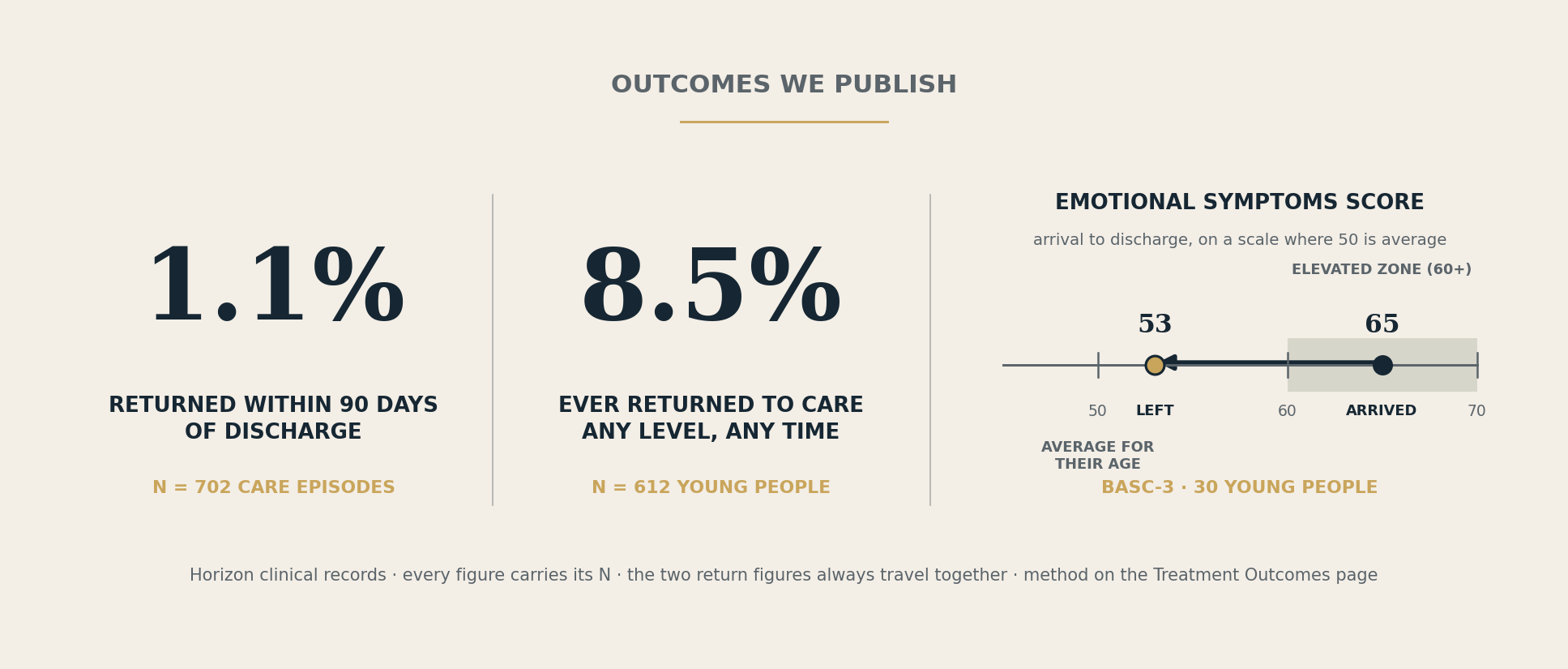
From our own clinical records, not a research study. See what we measure.
You don't have to sort this out alone. Our admissions team can talk through where your family is and what makes sense next.
Talk with our team