Jamie Humphrey
Head of Culture & Brand Integrity



One week your teen barely sleeps, talks a mile a minute, and takes risks that scare you. Next, they can hardly get out of bed. Big emotions are part of being a teenager — and most of the time, that's all this is.
But sometimes the swings are so extreme, so long-lasting, and so disruptive that they're pointing at something else.
If you've been searching for the symptoms of bipolar disorder in teens, you're trying to tell the difference between ordinary adolescence and a real condition — and that instinct to look closer is a good one.
At Horizon Recovery in Phoenix, Arizona, we specialize in caring for teens facing mental health challenges, including bipolar disorder and the co-occurring struggles that often come with it.
You don't have to sort this out alone.
Learn more about our teen mental health programs in Arizona or verify your insurance today.
Bipolar disorder is a mental health condition that causes extreme changes in mood, energy, and behavior. It used to be called manic depression. The shifts go well beyond ordinary moodiness.
Bipolar disorder is not the same as the ups and downs every young person goes through.¹ The mood changes are more extreme, they often arrive without an obvious trigger, and they come packaged with changes in sleep, energy, and the ability to think clearly.
The condition moves in episodes. A teen may go through a stretch of unusually high energy and elevated or irritable mood, then a stretch of deep low mood. These episodes typically last days or weeks — not an afternoon.
Knowing both sides of the pattern is what makes it recognizable.
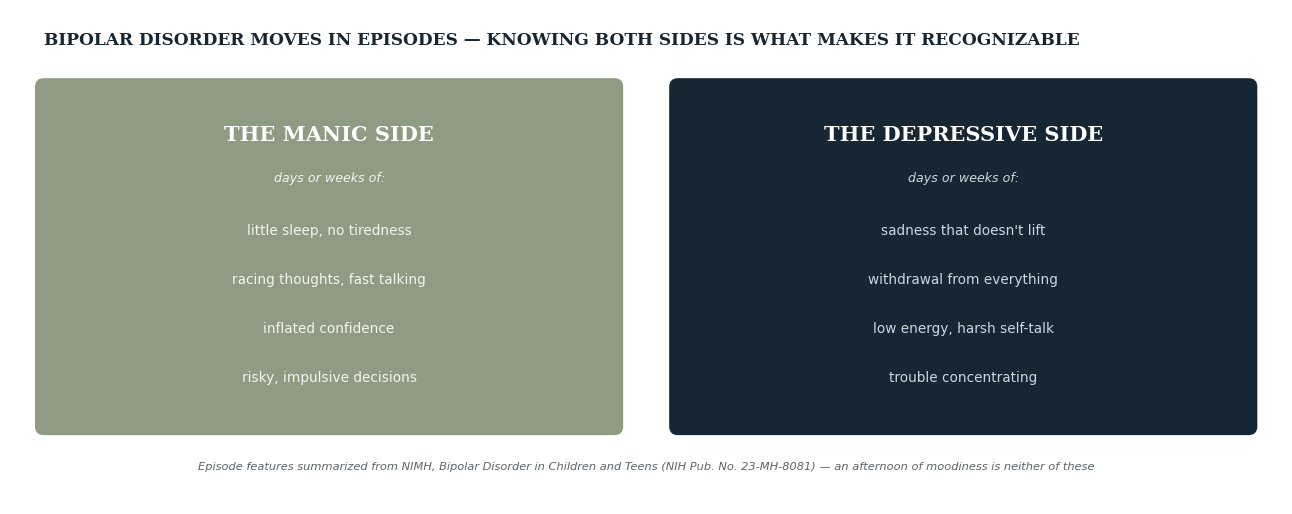
A manic episode is a period of unusually high or irritable mood paired with a marked jump in energy. Parents often describe it as their teen seeming like a different kid — not just in a bad mood, but noticeably unlike themselves.
Signs of a manic episode in teens can include:
During a manic episode, children and teens may seem unusually happy or silly, have a very short temper, or talk rapidly about many different subjects at once.¹ Some teens experience a milder version called hypomania, less intense, but still a real departure from their baseline.
The other side of bipolar disorder is depression: a stretch of low, sad, or empty mood alongside a drop in energy. For a lot of teens, this side is the heavier one.
Signs of a depressive episode in teens can include:
During a depressive episode, teens may feel very sad or down, complain of physical pain like stomachaches and headaches, sleep too little or too much, or feel worthless and guilty.¹ If your teen ever voices thoughts of suicide or self-harm, treat it as urgent and get help the same day.
Bipolar disorder in teens doesn't always sort itself into neat categories.
Sometimes both sides show up at once, which is confusing for parents and genuinely miserable for the teen.
In a mixed episode, a young person has manic and depressive symptoms at the same time — intensely energized and deeply sad in the same afternoon.¹
Mixed states are among the most distressing presentations, and they're one of the strongest reasons to get a professional evaluation rather than continuing to watch and wait.
This is the question that brings most parents to this page. Every teenager has mood swings, tests boundaries, and wants more independence. So where's the line?
Three things separate a mood episode from moodiness:
There's another layer worth understanding. Several bipolar symptoms overlap with other conditions. Certain signs can also appear with ADHD, depression, or substance use.²
That overlap is exactly why self-diagnosis is so unreliable — and why getting it right matters. A teen treated for the wrong condition can spend years not improving. It is not a rare mistake: more than 90% of the adolescents we screen arrive carrying at least one misdiagnosis, and more than 75% are being medicated for one.*1
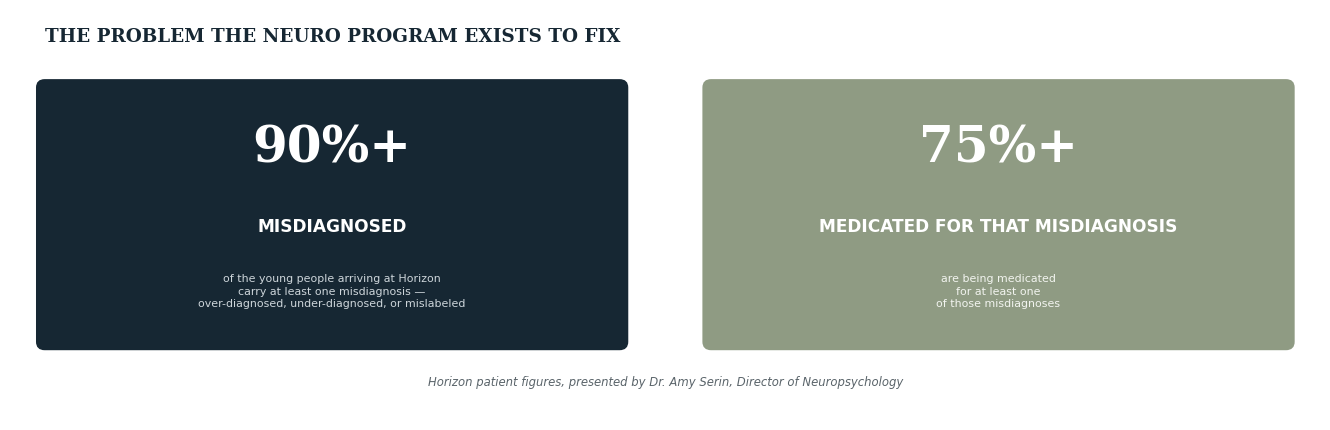
Callout — First brain, then behavior: This is the problem Horizon's Neuro Program exists to fix. Instead of assuming a previous label is right, we measure how your teen's brain is actually functioning — a 19-channel qEEG brain map, read by a neuropsychology team — and check every diagnosis against their own data. Ask any program you're comparing whether they can show you the same. [Link: Neuro Program page]
If you're not sure where your teen stands, our bipolar screening tool for parents is a reasonable place to start before you call anyone. It isn't a diagnosis; it's a way to organize what you're seeing. Our guide on telling a phase from something more [ADD INTERNAL LINK: Is It a Phase, or Something More? — URL needed] covers the same question more broadly.
For some families, bipolar disorder doesn't arrive alone. Teens living with intense, unpredictable moods sometimes reach for drugs or alcohol to flatten them out — and that complicates the picture fast.³
When a mental health condition and substance use occur together, it's called a co-occurring disorder, or dual diagnosis.
Treating one side and ignoring the other rarely holds. Dual diagnosis treatment for teens addresses the mental health condition and the substance use at the same time, which is what steadier, longer-lasting recovery tends to require.
If you're seeing early warning signs on that front, our guide to adolescent substance use [ADD INTERNAL LINK: Adolescent Substance Use: Early Signs & What to Do — URL needed] lays out what to look for and what to do next.
If the patterns described here sound familiar, the next step is a professional evaluation. Bipolar disorder cannot be diagnosed from a checklist. It takes a clinician trained to work with adolescents, and it takes a real look at history, not just this week.⁴
The encouraging part is that this condition is manageable. Steady, dependable treatment works better than treatment that starts and stops — consistency is the active ingredient.¹ Care usually combines medication and therapy, built around your teen specifically. Teen mental health treatment and family therapy give both your teen and your family tools to manage the condition together rather than separately.⁵
Not every teen needs the same intensity of care, and knowing the options ahead of time makes the first phone call easier.
Our breakdown of teen levels of care explains the difference between residential, PHP, IOP, and outpatient support, and what parents can expect from treatment answers the questions families usually ask us first.
If your teen is in immediate danger or is having thoughts of suicide, don't wait. Call or text the 988 Suicide and Crisis Lifeline any time for free, confidential support. In an emergency, call 911. Reaching out is one of the most protective things a parent can do.
Watching your teen swing between extremes is frightening, and the not-knowing is its own kind of exhausting. But you're already doing something that matters by learning the signs. With an accurate diagnosis and the right support, teens with bipolar disorder stabilize, and they go on to build good lives.
At Horizon Recovery, our team provides specialized, evidence-based care for adolescents in a safe and structured environment, and we work alongside your family the entire way.
You can see how we measure our results on our treatment outcomes page, read about the Horizon Guarantee, or get straight answers about how teen treatment is paid for.
Call us now at (623) 243-8992, or verify your insurance today to take the first step toward getting your teen the support they deserve.
*1 Horizon Recovery screening data, presented by Dr. Amy Serin, Director of Neuropsychology, in her 2026 keynote. The pair travels together: more than 90% arrive carrying at least one misdiagnosis, and more than 75% are being medicated for at least one of them.
1. National Institute of Mental Health. (2023). Bipolar disorder in children and teens (NIH Publication No. 23-MH-8081). https://www.nimh.nih.gov/health/publications/bipolar-disorder-in-children-and-teens
2. American Academy of Child and Adolescent Psychiatry. (n.d.). Bipolar disorder in children and teens (Facts for Families No. 38). https://www.aacap.org/AACAP/Families_and_Youth/Facts_for_Families/FFF-Guide/Bipolar-Disorder-In-Children-And-Teens-038.aspx
3. Wilens, T. E., Biederman, J., Kwon, A., Ditterline, J., Forkner, P., et al. (2004). Risk of substance use disorders in adolescents with bipolar disorder. Journal of the American Academy of Child & Adolescent Psychiatry, 43(11), 1380-1386. https://doi.org/10.1097/01.chi.0000140454.89323.99
4. McClellan, J., Kowatch, R., & Findling, R. L. (2007). Practice parameter for the assessment and treatment of children and adolescents with bipolar disorder. Journal of the American Academy of Child & Adolescent Psychiatry, 46(1), 107-125. https://doi.org/10.1097/01.chi.0000242240.69678.c4
5. Miklowitz, D. J., Axelson, D. A., Birmaher, B., George, E. L., Taylor, D. O., Schneck, C. D., Beresford, C. A., Dickinson, L. M., Craighead, W. E., & Brent, D. A. (2008). Family-focused treatment for adolescents with bipolar disorder: Results of a 2-year randomized trial. Archives of General Psychiatry, 65(9), 1053-1061. https://doi.org/10.1001/archpsyc.65.9.1053